The government asserts that the technical work of audiovisual forensic examination allowed for the addition of names and the strengthening of charges; the opposition, however, warns about the risk of stigmatization and the political use of the case.
Alongside Tolomeo's pretrial detention, the judge ordered the release of two other detainees involved in the disturbances in front of Congress.
However, for union and opposition sectors, the risk is that the case will be used to delegitimize social protest and toughen the criminal framework for demonstrations.
For the Government, the arrests and pretrial detention reinforce the 'zero tolerance' discourse against violent episodes.
The judge decided to keep the case within the local criminal jurisdiction, with charges related to carrying and handling dangerous materials, public intimidation, and resistance or assault on authority, among other offenses.
According to the official reconstruction, the accused was detained in a public place following a judicial order and voluntarily handed over the keys to his home, facilitating the procedure.
Rua's decision also included another high-impact move: he declined to transfer the case to federal jurisdiction, even though in the public debate some sectors had interpreted the events as a possible episode of terrorism or a federal matter due to the location and institutional context.
The decision was made this Tuesday by the head of the Criminal, Contravention, and Misdemeanors Court No. 6, Gonzalo Rua, at the request of prosecutors Malena Mercuriali and Mariano Camblong, from the Flagrancy Unit East, and consolidated a key change: the magistrate rejected referring the file to the federal sphere, framing the facts under figures from the Penal Code related to crimes against public security, public intimidation, and attacks on public administration.
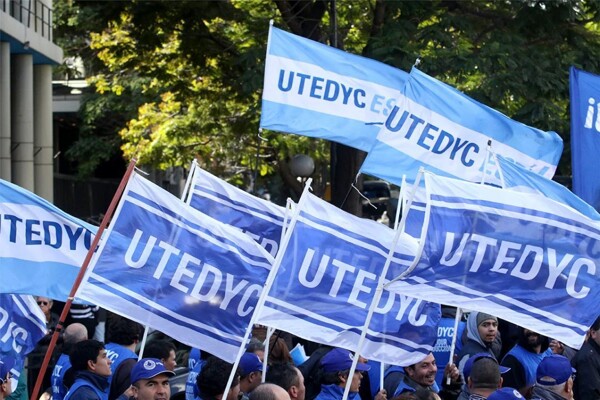
According to the accusation, Tolomeo would have had direct participation in the assembly and launching of incendiary devices against security forces during the riots that broke out in the vicinity of Parliament, within the framework of a massive mobilization called by unions and social organizations against the government's labor reform project.
The contrast—pretrial detention for the accused Molotov thrower and the release of other detainees—seeks to delineate responsibilities and hierarchize behaviors within the file.
The progress of the case adds pressure to a parliamentary week marked by the debate on labor reform and the pulse in the streets.
The case gained special public visibility because the scenes of violence, recorded in videos and live broadcasts, became one of the axes of the political dispute: the Government denounced 'organized attacks,' while opposition sectors and human rights organizations questioned the operation and police response.
The pretrial detention was ordered after investigators maintained that there was a procedural risk and the need to ensure the progress of the investigation.
Buenos Aires - February 17, 2026 - Total News Agency - TNA - Justice ordered the pretrial detention of Milton Tolomeo, identified as the protester who assembled and threw Molotov cocktails during the protest against the labor reform carried out on Wednesday, February 11, in front of Congress.
Both had criminal records, according to official information.
For the prosecution, the focus is not only on material damage but on the effect of intimidation and destabilization of public order at a crucial point in the democratic system.
The case is also framed in a sequence of measures following the incidents.
In the account of the investigation, the nickname 'Molotov anarchist' became an operational label based on the type of items found and seized material.
The raid on the home attributed to Tolomeo, located on Avenida Directorio in the Caballito neighborhood, provided evidence that the prosecution considers relevant to support the accusation.
The Minister of Security, Alejandra Monteoliva, had days earlier released a video with images of four suspects that the Government pointed to for the attacks, although Tolomeo did not appear in that initial recording.
One of them, 31 years old, was arrested by the City Police while sleeping in an ATM in the Belgrano neighborhood, and the second was detained in San Nicolás.
Subsequently, a broader list of alleged perpetrators was published, which fueled criticism of the identification criteria and the pace of official announcements.
With the case underway, the immediate key will be the solidity of the expert reports, the traceability of the seized materials, and the consistency between the audiovisual records and the attributed conduct.
According to sources from the case file, the identification of the accused was the result of an 'exhaustive' image analysis, which allowed him to be attributed to the preparation and launching of the Molotov cocktails despite his name not initially appearing in the lists of suspects published after the incidents.
Containers with alcohol and gasoline were also reported, as well as personal protective equipment such as a helmet and mask.
Among the seized items, investigators listed clothing compatible with what was worn on the day of the events, high-temperature gloves, flammable liquid containers, cell phones, and a computer.